
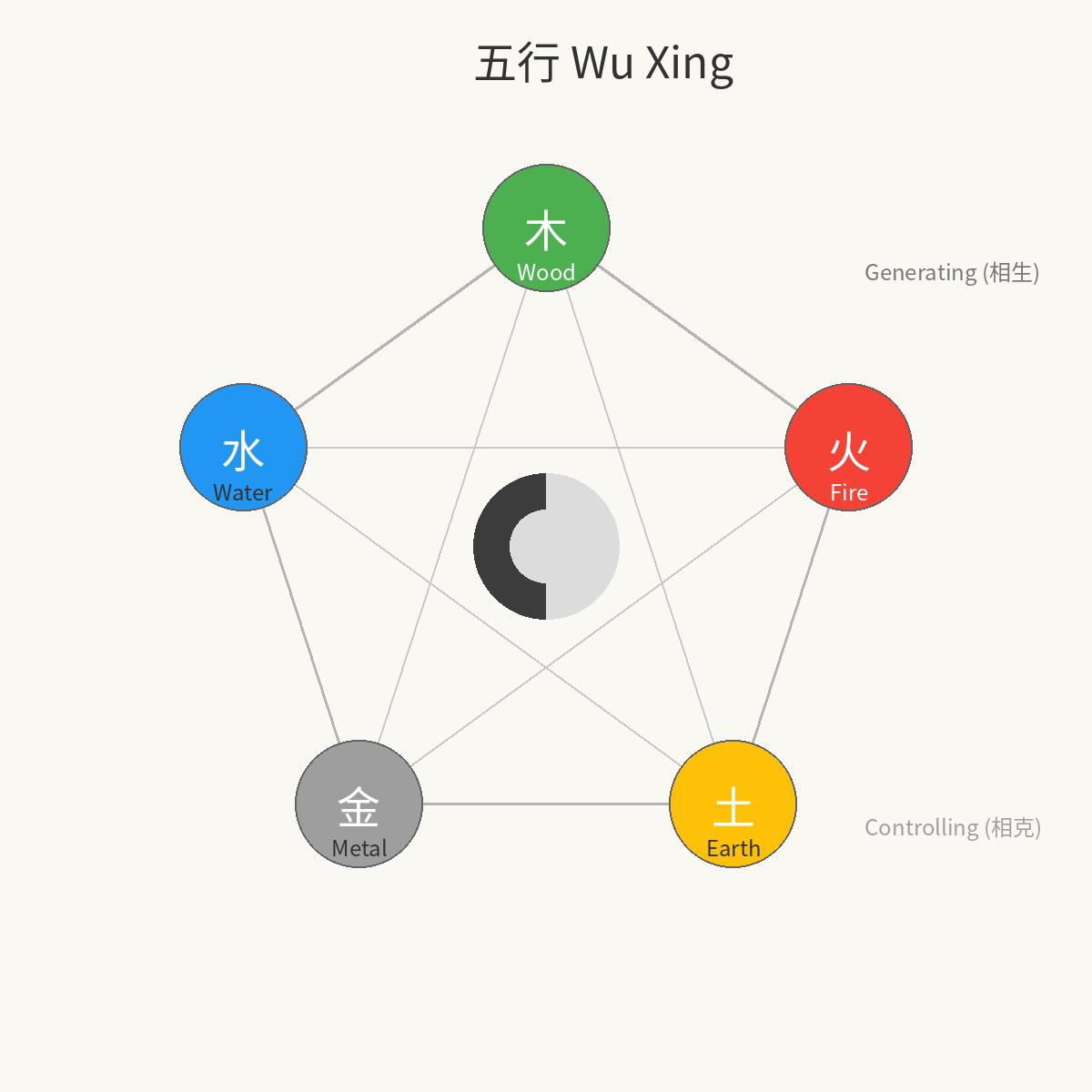
The Five Phases do not exist in isolation. They are constantly interacting through cycles of generation and control — a dynamic system of mutual nourishment and mutual restraint that maintains balance in the body, in the environment, and in human affairs.
The Generating Cycle (Sheng) #
The Generating Cycle describes how each phase produces or nourishes the next:
- Wood feeds Fire — add wood to a fire, it burns brighter.
- Fire creates Earth — fire reduces matter to ash, which becomes soil.
- Earth bears Metal — metals are mined from the earth.
- Metal collects Water — metal surfaces attract condensation; metaphorically, metal represents the contraction that gathers water.
- Water nourishes Wood — plants need water to grow.
In health, the Generating Cycle represents support and flow. In Chinese medicine, if the liver (Wood) is healthy, it supports the heart (Fire). If the kidneys (Water) are strong, they nourish the liver. When one phase is weak, the phase that generates it may also suffer — a principle that guides diagnosis and treatment.
The Controlling Cycle (Ke) #
The Controlling Cycle keeps the Generating Cycle from running out of control by imposing limits:
- Wood controls Earth — tree roots hold soil in place.
- Earth controls Water — dams and levees contain floods.
- Water controls Fire — water extinguishes fire.
- Fire controls Metal — fire melts and shapes metal.
- Metal controls Wood — axes cut trees.
The Controlling Cycle is not destructive in a negative sense — it is essential for balance. Without the Controlling Cycle, the Generating Cycle would be a runaway train. Fire would feed Earth endlessly, Earth would produce Metal without limit, and the system would collapse into chaos.
When Balance Fails #
Pathology occurs when these cycles go awry. In the Generating Cycle, a phase can be deficient (failing to nourish its child) or excessive (overwhelming its child). In the Controlling Cycle, a phase can over-control its target (think of a dam that completely stops a river) or rebel against its controller (Wood, instead of being cut by Metal, overgrows and dulls the axe).
These patterns describe not just physical illness but emotional and social dynamics. A leader (Metal) who controls too rigidly provokes rebellion. A creative impulse (Wood) that is never pruned grows into chaos. The wisdom of the Five Phases is the wisdom of balance — of knowing when to generate and when to control, when to nourish and when to restrain.