
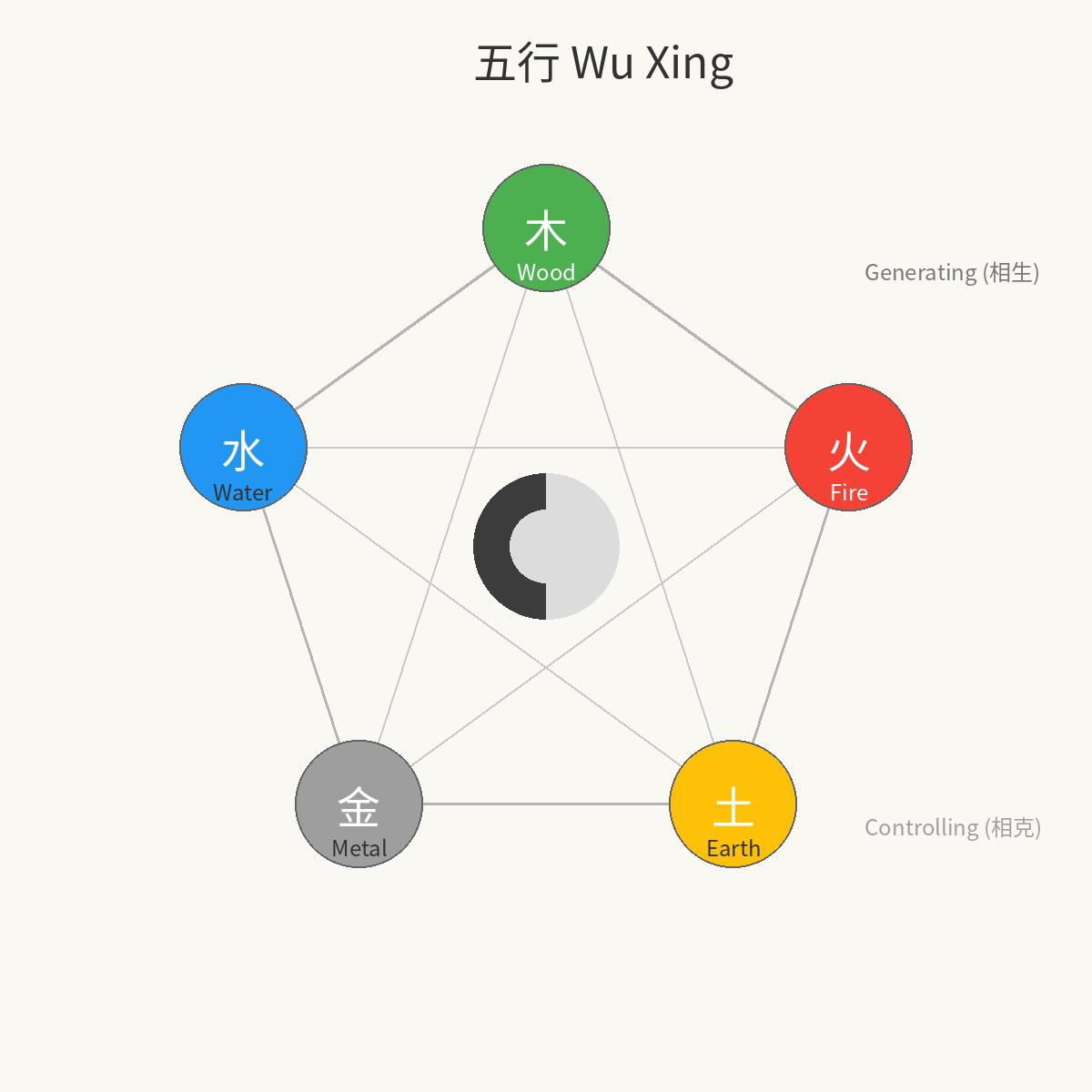
If you visit a Traditional Chinese Medicine practitioner complaining of headaches, do not be surprised if they ask about your digestion. In the Five Phase framework, the body is an integrated system, and symptoms in one area often originate in another. A headache may reflect liver qi stagnation (Wood imbalance) or kidney yin deficiency (Water imbalance) — and the treatment will address the root, not just the branch.
Organ Networks #
In TCM, each phase governs a pair of organs — one yin, one yang — and an entire network of associated tissues, emotions, and functions:
- Wood: Liver (yin) and Gallbladder (yang). Governs the smooth flow of qi, the sinews, the eyes, and the emotion of anger. The liver stores blood and is called the “general” of the body for its role in strategic planning.
- Fire: Heart (yin) and Small Intestine (yang), plus the Pericardium and Triple Burner. Governs the blood, the tongue, and the emotion of joy. The heart is the “emperor” — when it is disordered, everything suffers.
- Earth: Spleen (yin) and Stomach (yang). Governs digestion, the muscles, the mouth, and the emotion of worry. The spleen transforms food into qi and blood — it is the body’s central processing unit.
- Metal: Lungs (yin) and Large Intestine (yang). Governs respiration, the skin, the nose, and the emotion of grief. The lungs are the “prime minister,” managing the rhythm of breath and the body’s boundary with the outside world.
- Water: Kidneys (yin) and Bladder (yang). Governs water metabolism, the bones, the ears, and the emotion of fear. The kidneys store jing — the body’s constitutional essence, inherited from the parents — and are the root of all yin and yang.
Diagnostics Through the Five Phases #
A TCM practitioner uses the Five Phases as a diagnostic framework. The patient’s complexion, voice, body odor, and emotional state are all clues. A greenish complexion suggests Wood imbalance — the liver. A reddish face suggests Fire — the heart. A sallow, yellowish complexion suggests Earth — the spleen. A pale, white complexion suggests Metal — the lungs. A dark, bluish complexion suggests Water — the kidneys.
The tongue and pulse provide additional information, all mapped onto the Five Phase grid. Treatment — whether acupuncture, herbs, dietary therapy, or qigong — is designed to restore balance by strengthening deficient phases and calming excessive ones.
A Different Kind of Science #
Western medicine excels at acute interventions — antibiotics for infections, surgery for trauma. TCM excels at chronic conditions and prevention — the slow, patient work of restoring systemic balance. The two systems are not rivals but complements, and in China’s modern hospitals, they work side by side. A cancer patient may receive chemotherapy from the Western medicine department while the TCM department prescribes herbs to strengthen the spleen and stomach, mitigate side effects, and support the body’s constitutional resilience.