
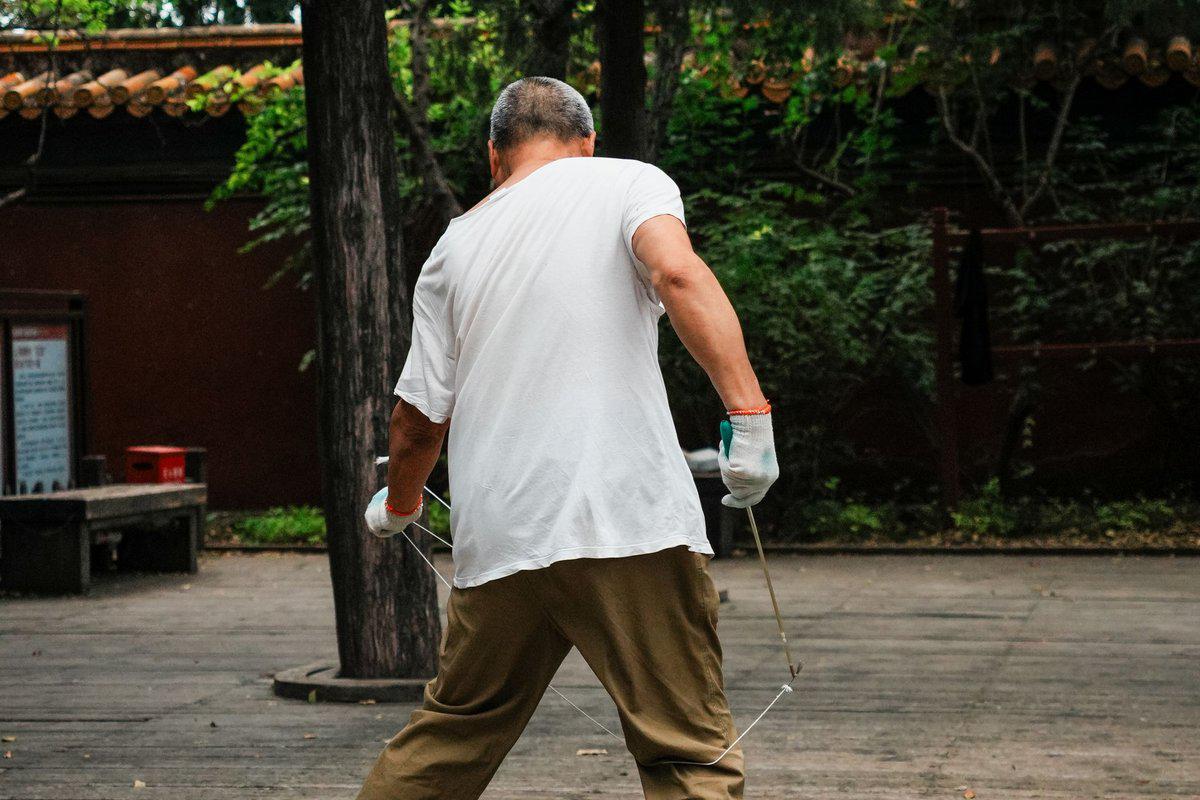
Every morning in parks across China, you will see them: people moving in slow, synchronized motion, as if swimming through air. They are practicing Tai Chi (taijiquan), and the graceful slowness of their movements conceals a martial art, a health practice, and a complete philosophy of how to move through the world.
The Origin Story #
Legend traces Tai Chi to the 12th century, when the Daoist sage Zhang Sanfeng witnessed a fight between a snake and a crane on Wudang Mountain. The crane attacked with sharp, direct strikes; the snake evaded with soft, fluid movements. Zhang realized that softness could overcome hardness, that yielding could be a form of strength. From this insight, the principles of Tai Chi were born.
Historically, Tai Chi emerged as a distinct martial art in Chen Village, Henan Province, in the 17th century. The Chen family style combined existing martial techniques with Daoist breathing exercises and the philosophical framework of the I Ching. Over generations, it evolved into the major styles practiced today: Chen, Yang, Wu, and Sun.
More Than Exercise #
Tai Chi is often described as meditation in motion. The slow, continuous movements demand complete attention — the mind cannot wander when every muscle, joint, and breath is engaged in a precise, flowing sequence. This is the state of mindful presence that Zen practitioners seek in seated meditation, achieved through movement instead of stillness.
Physically, Tai Chi improves balance, flexibility, and cardiovascular health. Studies at Harvard Medical School have shown it to be particularly effective for preventing falls in older adults. The slow weight shifts strengthen the legs and core; the extended postures open the joints; the deep breathing calms the nervous system.
The Philosophy in the Form #
Every Tai Chi movement embodies Chinese philosophy. The constant shifting of weight from one leg to the other is the dance of yin and yang. The circular, never-ending flow of the form echoes the Daoist concept of the eternal cycle. The principle of using four ounces to deflect a thousand pounds is the wisdom of the Daodejing: “The soft overcomes the hard; the gentle overcomes the rigid.”
To practice Tai Chi is to rehearse a way of being: centered, responsive, and calm in the face of force.